Configuring R&D Workstation Systems for a Global Aerospace Manufacturer
Industry: Aerospace & Defense, Product & Parts Manufacturing Function: Research & Development Furnisys Program: Workstation Systems, Link Uprighter System, Storage & Locker Systems
Snapshot
- Situation: A global aircraft and aerospace systems manufacturer needed workstations and storage across multiple R&D zones — wire-harness prep, sub-assembly, and general engineering and testing.
- Challenge: Each zone had fixed dimensional constraints, mixed tool and instrument requirements, and a need for ESD safety without slowing down high-frequency tool access.
- Approach: Furnisys custom-configured linear and L-shaped workstations, mobile and tall storage cabinets, and PPE lockers around a common Link Uprighter system.
- Outcome: Tools, instruments, and consumables placed at point of use across every zone, supporting 5S discipline and continuous R&D operation.
Customer Context
The client operates an advanced R&D and engineering center supporting aircraft and aerospace systems development. Activities across the facility included wire-harness preparation and crimping, mechanical and electrical sub-assembly, and general engineering and testing, each carried out in a clearly defined zone with its own layout and space constraints.
Problem Definition
Because each zone had fixed dimensional limits, off-the-shelf furniture wasn’t going to integrate cleanly. The client needed:
- Worktops able to withstand chemical exposure, tool impact, and, in electronics-handling zones, ESD-sensitive conditions common to environments governed by aerospace quality standards such as AS9100.
- Reliable overhead and point-of-use storage for frequently used tools and test hardware.
- Task lighting suited to precision crimping, inspection, and assembly work.
- Provisions for pneumatic hose routing, waste disposal, and secure, lockable storage for high-value test equipment.
- Furniture built to exact client-supplied dimensions, not standard catalogue sizing.
System Approach
Furnisys selected a custom-configuration route where standard product sizing didn’t match the client’s shared dimensions, while keeping every workstation built on the same underlying system logic, the Link Uprighter platform, so tool organization, lighting, and storage stayed consistent across zones even where the furniture itself was bespoke.
Execution
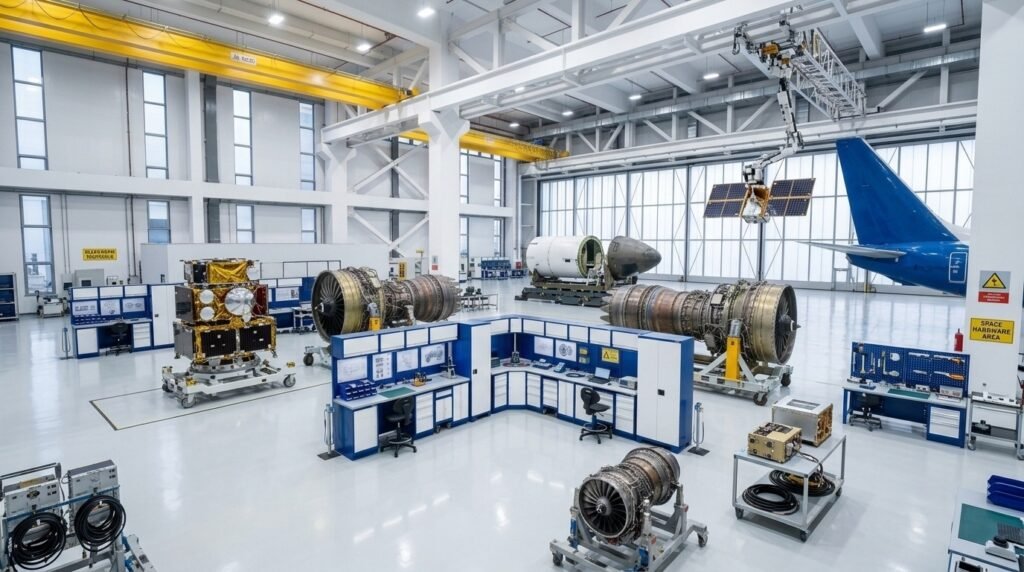
Linear Workstations, configured for wire-harnessing, crimping, and structured assembly. GI-cladded worktops handled repeated tool use and chemical exposure; ESD-compatible provisions protected sensitive components where needed. A rear-mounted Link Uprighter with pegboards held crimping tools, cutters, and torque tools at ergonomic reach, with spanner trays, Allen-key holders, and bin strips supporting 5S organization. Overhead cabinets with under-cabinet task lighting stored fixtures not needed continuously. Air hose attachment points and a swing-arm tool rail kept pneumatic tools accessible without hoses crossing the work surface. Custom base cabinets and mobile cabinets, with recessed handles and lockable heavy-duty castors, completed each station.
L-Shaped Workstations, built for sub-assembly and ESD-sensitive electronics work, using postform laminated worktops fitted with ESD mats. The L-shape followed the client’s existing layout, with a corner-configured overhead cabinet making the junction usable rather than dead space. Task lighting, pneumatic attachment points, and custom base cabinets matched the linear stations’ logic, adapted to a two-surface layout.
Storage & Lockers: Tall cabinets with adjustable shelves, drawers, and door-activated LED lighting secured high-value R&D instruments and precision tools, with perforated bodies for hook and bin-strip organization. Glass-door storage kept PPE and lab coats visible while secured. Personal lockers with hanging rods and multi-point locks supported everyday employee storage separate from active work zones. A mobile cabinet, fitted with a Link Uprighter, integrated power module, and castors rated to 240 kg, gave technicians a movable support station for test setup across zones.
Outcome
Every workstation and storage unit was matched to a specific function rather than deployed as generic furniture, so tools, instruments, and consumables stayed available at the point of use across zones. The configuration reinforced 5S discipline in a facility running continuous R&D, assembly, and testing activity.
What This Means for Aerospace Manufacturing in India
As India’s aerospace manufacturing base expands — most recently with Mahindra’s incorporation of Novavayu Aerospace to build aircraft and aerospace products domestically- new and scaling R&D and production facilities face the same functional questions this case study addresses: how to organize ESD-sensitive assembly work, keep tools at point of use, and configure storage that scales as engineering teams grow. Furnisys’s workstation systems are built to answer exactly that, regardless of whether a facility is a global manufacturer’s R&D center or a new domestic aerospace entrant setting up its first production line.
System Continuity
The Link Uprighter platform used across every workstation means the client can extend the same configuration logic, pegboards, overhead storage, task lighting, and mobile cabinets into new zones as R&D activity expands, without redesigning the underlying system.
Frequently Asked Questions
What furniture systems are needed for aerospace R&D and wire-harness assembly areas? Aerospace R&D zones typically need chemical- and impact-resistant worktops, ESD-compatible surfaces for electronics-sensitive work, integrated task lighting, pegboard-based tool organization, and secure storage for high-value test equipment, configured to each zone’s specific activity rather than as generic furniture.
What is an ESD-compatible workstation, and why does aerospace R&D need one? An ESD-compatible workstation dissipates static charge that could otherwise damage sensitive electronic components, such as control boards and connectors, during handling. It’s essential wherever engineers assemble or test electro-mechanical sub-modules.
How do modular workstation systems support 5S in engineering labs? Systems like the Link Uprighter assign fixed, visible locations for tools and consumables, pegboards, bin strips, and labeled trays, so items are always returned to the same point of use, which is a core 5S requirement.
Can workstation systems be customized to fit a specific facility layout? Yes. When standard configurations don’t match a facility’s dimensional constraints, custom-sized worktops, cabinets, and corner units can be built on the same underlying system platform, keeping tool organization and lighting consistent even where the furniture itself is bespoke.
What storage protects high-value test equipment in R&D centers? Tall, lockable cabinets with adjustable shelving, multi-point locks, and door-activated interior lighting are typically used to secure precision instruments and calibration units while keeping them quickly retrievable.
